界面聚合(Interfacial Polymerization, IP)工藝是制備高性能分離膜、功能薄膜和復合膜材料的重要方法,廣泛應用于水處理、分子分離和功能界面構筑等領域。然而,在界面限域處發生的反應與擴散現象異常復雜且無定量表征手段而被視為材料化學領域長期未解的難題之一。
近期,香港科技大學楊晶磊教授團隊聯合加州理工大學William A. Goddard III教授團隊,以TEPA(四乙烯五胺)與 HMDI(4,4''''-二環己基甲烷二異氰酸酯)為快速反應模型系統,結合量子化學和機器學習力場從分子層面模擬預測和實驗觀測驗證的雙手段,證實了水分子在界面反應中有效降低質子轉移能壘的催化機理和反應擴散路徑,為深刻理解界面處反應動力學機制與精準調控聚合物膜材微觀形貌提供了清晰參考。
2026年3月16日,相關研究成果以 “Interfacial Polymerization of TEPA and HMDI: The Role of Water” 為題發表于催化領域頂級期刊 ACS Catalysis上。文章的共同第一作者為劉碧媛博士和張雍淋博士,文章的通訊作者為William A. Goddard III教授, 楊晶磊教授。文章通訊單位為加州理工學院、香港科技大學。

核心發現
本研究結合量子化學計算、分子動力學模擬與實驗表征,從分子尺度揭示了水在界面聚合中的關鍵作用。研究發現,單個水分子并非只是界面環境的一部分,而是能夠直接參與反應過程。水分子可在胺基與異氰酸酯基之間構建氫鍵橋梁,顯著降低質子轉移能壘,從而加快界面聚合反應。研究闡明了反應更傾向于發生在有機相一側的分子原因。模擬與實驗結果共同表明,HMDI 更穩定于十六烷相,而 TEPA 更容易向界面遷移并發生反應,這決定了聚合主要在有機相側推進。該工作從理論和實驗兩方面揭示了水促進界面聚合、界面環境調控反應位置的本質機制,為膜材料界面聚合過程的動力學調控、結構設計與形貌優化提供了新的理論視角。這一發現說明,界面微環境中的水不僅影響反應速率,也可能進一步影響膜層的形成位置、結構致密性和最終形貌。
圖文快解
為揭示 TEPA 與 HMDI 界面聚合中的質子轉移機制,作者首先建立了具有代表性的分子模型。圖1展示了 TEPA、HMDI 及初始中間體結構,其中選取了 TEPA 的伯胺和仲胺位點,以及 HMDI 的兩種典型構型,用于表征界面聚合中可能的反應情形。在此基礎上,作者進一步比較了無水條件下的直接質子轉移與單個水分子參與的橋接質子轉移兩條路徑。圖2概括了本文研究的主要反應模型,用于分析水是否能夠在胺基與異氰酸酯基之間充當“質子轉移橋梁”。需要指出的是,本文并未考慮異氰酸酯基與水的直接反應,因為這一路徑能壘較高,在常規條件下難以發生。

Figure 1. Molecular structures of the IP process studied in this work. (a) Molecular structure of TEPA. (b-d) Three conformers of HMDI: (b)trans-trans-HMDI, (c)cis-trans-HMDI, and (d)cis-cis-HMDI. (e) Representative intermediate formed in the initial step of the reaction between TEPA and HMDI, which ultimately leads to a cross-linked polymer network.
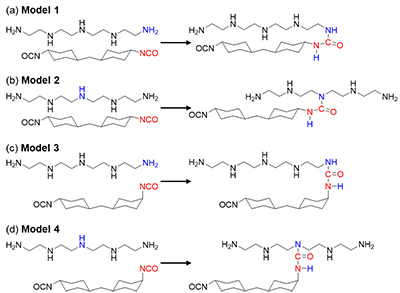
Figure 2. Schematic of the reactant and product for the direct proton transfer reaction between TEPA and HMDI investigated. (a) Primary amine of TEPA with trans-trans-HMDI (Model 1), (b) Secondary amine of TEPA with trans-trans-HMDI (Model 2), (c) Primary amine of TEPA with cis-trans-HMDI (Model 3), and (d) Secondary amine with cis-trans-HMDI (Model 4).
作者系統比較了 TEPA 與 HMDI 在不同環境下的質子轉移路徑。結果表明,無水條件下的直接質子轉移能壘較高,尤其在水環境中更難發生,這與實驗中界面聚合快速進行的現象并不一致。相比之下,當單個水分子參與時,質子轉移能壘顯著降低,反應速率提升多個數量級。也就是說,水分子雖然不是主反應物,卻能在胺基與異氰酸酯基之間充當高效的“質子傳遞橋梁”,從而使界面聚合在室溫下快速發生。此外,不同 HMDI 構型和 TEPA 胺位點之間的差異并不明顯,說明真正決定反應效率的關鍵,不是分子構型本身,而是水是否參與了質子轉移過程。

Figure 3. Calculated reaction pathways between TEPA and HMDI. (a, b) Electron-pushing mechanisms for the direct and single water molecule assisted proton transfer, respectively. (c)-(e) Free energy profiles of direct proton transfer in the gas phase, implicit hexadecane, and implicit water, respectively. (R, TS, and P represent reactant complexes, transition states and products, respectively. (f)-(h) Free energy profiles of single water molecule assisted proton transfer. The energies for separated reactants are available in Table S3 to Table S6. Additionally, the energies for reactions (c)-(h) and their corresponding cartesian coordinates are provided in Table S14 to Table S17, respectively.
作者進一步考察了更多顯式水分子的影響。結果表明,直接質子轉移始終最不利,而有水參與時反應明顯更容易發生。整體來看,局部水環境越豐富,越有助于穩定過渡態并促進質子傳遞。同時,誤差校正結果顯示這一趨勢具有較高可靠性。圖4進一步說明,水不僅能作為單個“質子橋”參與反應,周圍的微觀溶劑化環境也會持續增強其促進作用。
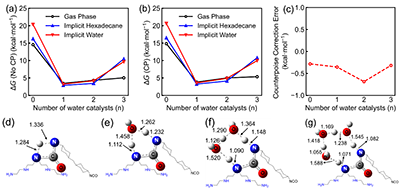
Figure 4. Influence of the number of water catalysts and counterpoise (CP) correction on ?G. (a) ?G for the reaction between TEPA (secondary amine) and HMDI (trans-trans-HMDI) without CP corrections. (b) ?G with CP. (c) Energy differences between results without and with CP correction. (d-g) Transition state structures for the four investigated cases in the gas phase.
水為何能顯著促進質子轉移?作者進一步分析了反應中的氫鍵結構。結果表明,無水條件下的氫鍵作用較弱,不利于質子高效遷移;而單個水分子參與后,可在反應物之間搭建更穩定、更接近理想構型的氫鍵橋,從而形成更有利的傳遞路徑。分子動力學結果也顯示,TEPA 的胺基更容易與水形成穩定氫鍵,而不會與正十六烷形成類似相互作用。這說明,在界面聚合過程中,真正促進反應進行的是界面附近水分子所構建的氫鍵網絡。
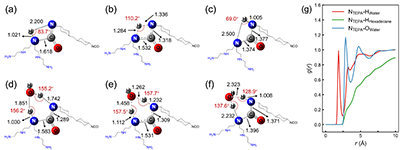
Figure 5. Hydrogen bond structures and solvation analysis for the TEPA-HMDI reaction. (a)-(c) Optimized geometries of the reactant, transition state, and product for direct proton transfer. (d)-(f) Optimized geometries of the reactant, transition state, , and product for single water molecule assisted proton transfer. (g) Radial distribution functions for atom pairs in the water/hexadecane solvated systems.
界面聚合為何更傾向發生在正十六烷相一側?作者從分子相互作用能出發,分析了 TEPA 和 HMDI 在水相與有機相中的分配行為。基于微調后的 MACE 機器學習力場模擬結果,TEPA 與水的相互作用更強,而 HMDI 則更偏好正十六烷相。這意味著,在界面附近,更可能是 TEPA 從水相向有機相側靠近并與 HMDI 發生反應,而不是 HMDI 進入水相。因此,圖6從分子層面解釋了為何聚合更傾向于在正十六烷側推進。

Figure 6. Accuracy of the fine-tuned MACE FF and calculated interaction energies. Comparison of predicted forces (a) and energies (b) between the Original MACE-MPA-0 model and DFT references. Comparison of predicted forces (c) and energies (d) between the fine-tuned MACE-MPA-0 model and DFT references, the corresponding MAE and RMSE values are provided. (e) Interaction energies between TEPA or HMDI and H2O or hexadecane molecules.
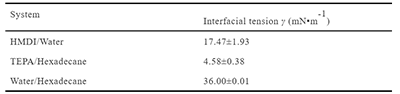
作者進一步結合分子動力學模擬與懸滴法界面張力實驗,從分子遷移與界面行為兩個層面驗證了聚合位置。結果表明,TEPA 更容易在水相中分散并向界面遷移,而 HMDI 主要停留在有機相一側。這一分布與擴散特征說明,界面聚合并不是在水相內部發生,而是更可能集中在靠近正十六烷一側的界面區域,與前面的理論分析相一致。
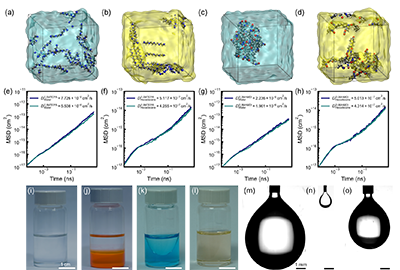
Figure 7. Simulation and experiment-based diffusion and solubility behaviors of TEPA and HMDI in water and hexadecane. (a)-(d) Solute morphologies of TEPA in water, TEPA in hexadecane, HMDI in water, and HMDI in hexadecane studied by MD simulations, respectively. (e)-(h) Mean square displacement curves and corresponding diffusion coefficients of TEPA and HMDI in water and hexadecane obtained from MD simulations. (i)-(l) Experimental observations of solubility behavior. (i) TEPA is completely miscible in water, forming a homogeneous solution. (j) TEPA exhibits phase separation in hexadecane, with hexadecane in the upper layer and TEPA in the lower layer. (k) HMDI forms a hemispherical aggregate in water, surrounded by hydration shells. (l) HMDI is homogeneously dissolved in liquid hexadecane. (m)-(n) Pendant-drop images used for interfacial tension measurements. (m) Water drop in hexadecane, (n) TEPA drop in hexadecane, and (o) HMDI drop in water.
Table 2. Interfacial tensions measured by pendant-drop method at 298.15 K
實驗上,作者利用顯微成像、熒光成像和微流控實驗,直接觀察了界面聚合的發生位置與早期反應過程。結果表明,有水條件下界面附近會迅速形成明顯反應區,且聚合主要發生在油相一側;而無水條件下幾乎不發生明顯聚合。這說明,水在界面聚合中不僅有助于維持穩定界面,更能通過氫鍵作用直接提升 TEPA 與 HMDI 的反應活性。尤其在反應初始階段,體系可在 100 ms 內快速成膠,進一步表明表面水分子對 TEPA 的活化作用,是加速界面聚合的重要原因。
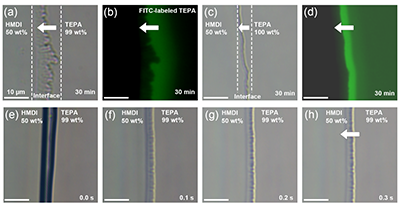
Figure 8. Overview of the formation of interfacial polyurea. (a)-(b) Microscopic and fluorescence images of polyurea formation and clear growth after 30 mins at the interface of the experimental group. (c)-(d) Microscopic and fluorescence images of polyurea formation and unclear growth after 30 mins at the interface of the control group. (e)-(h) Early formation process of polyurea upon direct mixing of 99 wt% TEPA and 50 wt% HMDI with increasing time. The scale bars in panels (b) to (h) are identical to that in (a). The arrows in (a)-(d) and (h) indicates the polymer growth direction.
結果展望
本研究結合量子化學計算、分子動力學模擬和實驗表征,系統揭示了 TEPA 與 HMDI 界面聚合的分子機制。結果表明,水分子能夠顯著降低質子轉移能壘,充當連接胺基與異氰酸酯基的關鍵“橋梁”,從而促進室溫下的快速聚合。同時,模擬結果顯示,TEPA 更容易從水相向有機相側靠近,而 HMDI 更傾向停留在正十六烷相中,這從分子層面解釋了聚合更可能發生在靠近油相一側的界面區域。實驗結果也進一步驗證了這一點:聚合主要出現在油相側,并在水輔助下表現出更快的反應速率和更明顯的凝膠形成。總體而言,該工作揭示了 “水促進反應、油相側成膜” 的關鍵機制,總體而言,該工作揭示了界面聚合膜形成過程中“水促進反應、油相側成膜”的關鍵機制,為聚酰胺/聚脲類界面聚合膜及其他功能薄膜材料的反應動力學調控、界面結構設計和膜層形貌優化提供了新的理論視角。
原文鏈接:https://pubs.acs.org/doi/10.1021/acscatal.5c08183
- 香港科技大學楊晶磊教授團隊 Adv. Mater.:機器學習輔助構建界面聚合微膠囊化的定量理性設計范式 2026-01-25
- 浙江大學肖銳研究員團隊 AFM:機器學習輔助4D打印液晶彈性體復合結構快速逆向設計 2025-12-13
- 復旦大學陳茂課題組 Angew:競聚率指紋 - 機器學習與序列調控之橋 2025-10-31
- 山東農大劉峰/張大俠團隊 AFM:界面聚合過程中油相親水性對膜形成動力學的多角度影響 2026-02-11
- 東華大學武培怡/吳慧青團隊 Nat. Commun.:低共熔溶劑/烷烴界面聚合助力制備高性能聚酰胺有機溶劑納濾膜 2025-09-26
- 華科大/哈工大 Adv. Mater.:類固相限域界面聚合 - COP 膜受控 2D 生長的通用平臺 2025-07-16